Morse Code Alphabet
Every letter, number and sign in Morse code. Tap any character to hear it.
Played at 20 WPM with a 600 Hz tone.
Letters
Numbers
Punctuation
Prosigns
Accented letters
Japanese kana (Wabun)
How to read the chart
A dot is a dit, a short signal one unit long; a dash is a dah, three units long. Say them out loud instead of spelling them: A is di-dah, B is dah-di-di-dit, K is dah-di-dah. That sound is what you will actually meet.
The codes are not random: the most common letters got the shortest codes. E is a single dit and T a single dah, while rare letters like Q and Y take four signals.
Why the chart is a slow way to learn
Memorizing the chart teaches you to see dots and dashes and translate them in your head. That works for the first few words per minute, then hits a wall: at around 10 WPM a letter is over before you have finished counting it.
Operators read Morse the way you hear words. Each letter has a shape in sound that they recognize at once. The Koch method trains exactly that, starting at full speed with just two letters.
Prosigns
Prosigns are procedure signals sent as a single character and written with a bar over the letters. Sending them as separate letters would change their meaning, so the gaps between the letters are left out.
Japanese kana (Wabun)
Wabun is the Japanese Morse code for kana. It reuses the same patterns as the Latin alphabet, so operators announce the switch with a prosign. Voiced sounds add a mark: ガ is カ followed by ゛ (di-dit), and パ is ハ followed by ゜.
 Cadenza for iPhone and Android
Stop reading Morse. Start hearing it.
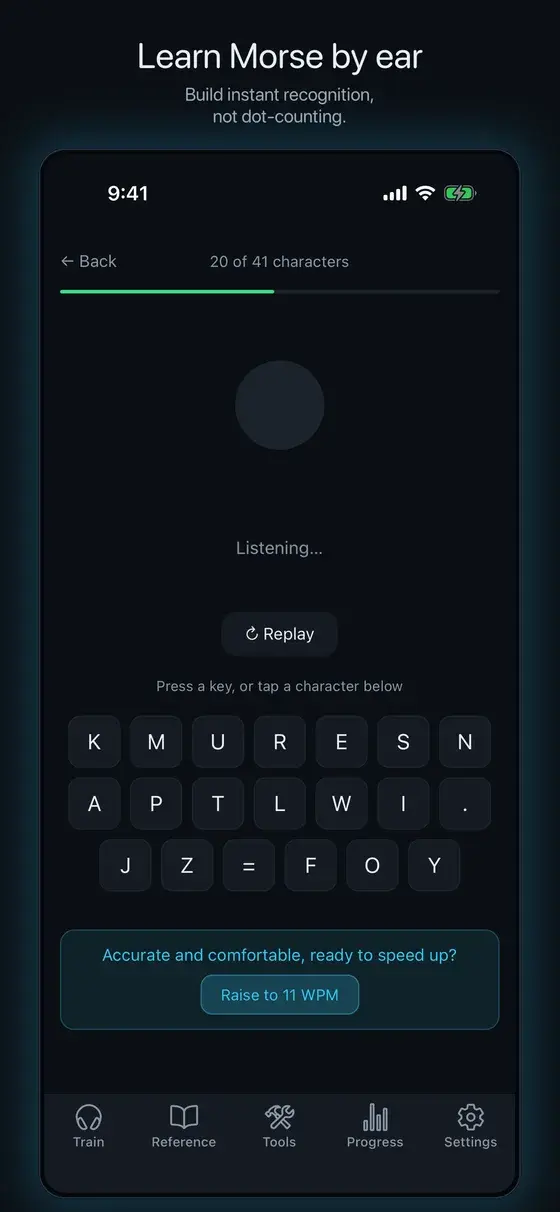
Cadenza teaches Morse code by ear with the Koch method: two letters at full speed, then one more each time you get them right. It notices which letters you mix up and drills exactly those.
- All 41 characters, then words, callsigns and QSO practice
- Two-way translator, microphone decoder and Morse postcards
- Sound, light and vibration. Works offline