Morse Code Translator
Type text to get Morse code, or paste dots and dashes to read them. Hear it, watch the light, save the sound.
How to use the translator
- 01
Type or paste text in the Text box. The Morse code appears as you type, with a space between letters and a slash between words.
- 02
To read a Morse message, type it in the Morse box instead. Dots can be . or •, dashes - or —. Put a space between letters and a slash or two spaces between words.
- 03
Press Play to hear it. Set the speed in words per minute, turn on the light or vibration, or download the sound as a WAV file to send to someone.
How Morse code timing works
Morse code is a rhythm, not a picture. Everything is measured in one unit of time: a dit lasts one unit and a dah three. Inside a letter the gap between signals is one unit, between letters three units, and between words seven. The bars above are drawn in exactly those proportions.
Speed is counted in words per minute (WPM), with the word PARIS as the standard: it is exactly 50 units long, gaps included. At 20 WPM one unit lasts 60 milliseconds, so a dit is 60 ms and a dah 180 ms. The rule of thumb: one unit in milliseconds is 1200 divided by the WPM.
Farnsworth spacing keeps every letter at full speed but stretches the gaps between letters and words. You hear the real rhythm of each character and still get time to think. Most learners start this way; switch it on in the sound settings to hear it.
Writing Morse code down
In text, Morse is written with dots and dashes: a space between letters and a slash between words, so HELLO WORLD becomes .... . .-.. .-.. --- / .-- --- .-. .-.. -..
Prosigns are procedure signals sent as one character with no gap between their letters, such as SK for end of contact or AR for end of message. Type them in angle brackets, <SK>, and the translator sends them as a single sign. SOS is the best known: ...---... as one unbroken sequence.
A # in the output means the character has no Morse code. Accented letters without a code of their own are sent as their base letter, so á becomes A, while letters like É, Ñ and Ü keep their own codes.
 Cadenza for iPhone and Android
Stop reading Morse. Start hearing it.
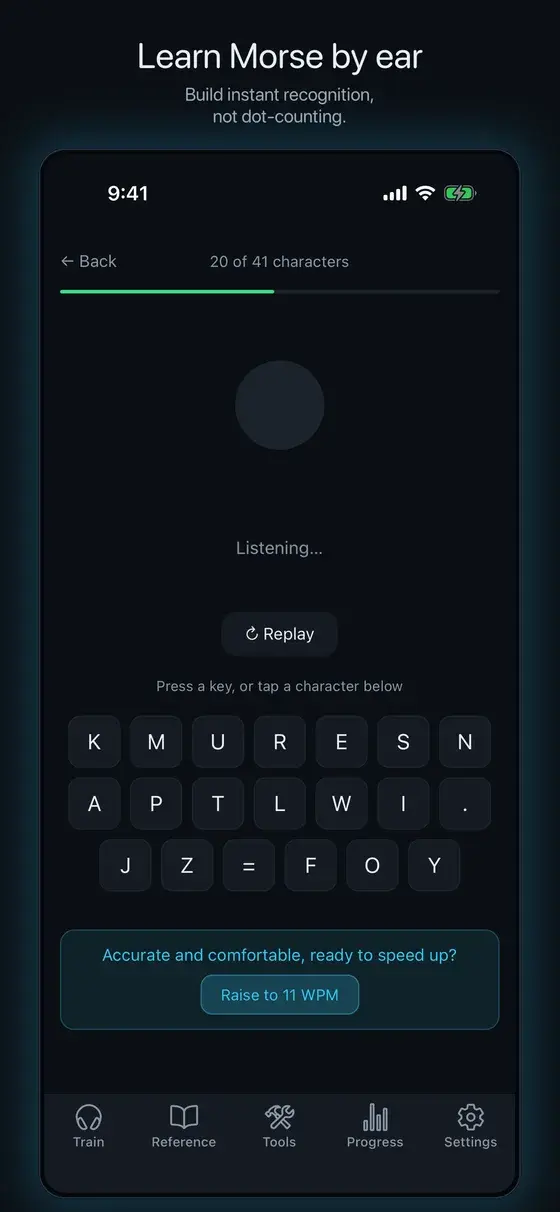
Cadenza teaches Morse code by ear with the Koch method: two letters at full speed, then one more each time you get them right. It notices which letters you mix up and drills exactly those.
- All 41 characters, then words, callsigns and QSO practice
- Two-way translator, microphone decoder and Morse postcards
- Sound, light and vibration. Works offline
Japanese kana: Wabun code
Japan has its own Morse code for kana, called Wabun (和文モールス符号). Type hiragana or katakana and the translator switches to Wabun by itself: voiced kana such as ガ are sent as カ followed by the voicing mark ゛. To read Wabun, set Decode as to Japanese, because Wabun reuses the same dit and dah patterns as the Latin letters.
Questions
How do I translate Morse code to English?
Type or paste the dots and dashes in the Morse box, with a space between letters and a slash or two spaces between words. The text appears in the Text box as you type. A # means the translator could not read that letter, usually because two letters ran together without a space.
What is SOS in Morse code?
... --- ... : three dits, three dahs, three dits. It is sent as one continuous signal with no gaps between the letters, which makes it a prosign rather than the three letters S, O and S.
What speed should I use?
20 WPM is a common everyday speed. If you are learning, keep the letters at 18 to 20 WPM and slow the overall speed with Farnsworth spacing, rather than slowing everything down. That way each letter keeps the sound you will hear on air.
Can I learn Morse code from the chart?
You can look letters up, but reading a chart teaches you to count dots and dashes, and counting stops working at around 10 WPM. Learning each letter as a sound takes you much further. The Learn page has a free first lesson.
Is my text sent anywhere?
No. Translation and sound run entirely in your browser. A share link carries the message inside the link itself, after the # sign, so it never reaches our server.
Can I decode Morse code from audio?
Not on this site yet. The Cadenza app has a decoder that listens through the microphone and turns clean Morse tones into text.