Q-codes and CW abbreviations
The Q-codes and abbreviations you hear in a Morse contact, each with its meaning, its dits and dahs and a button to hear it. Search the list, pick a speed, then follow a whole contact line by line.
Q-codes
With a question mark a Q-code asks, without one it answers. The meanings follow the ITU list; where hams use a code differently, the On air line says how.
- QRG−−·− ·−· −−·
- QRG?
- Will you tell me my exact frequency?
- QRG
- Your exact frequency is ... kHz.
- QRL−−·− ·−· ·−··
- QRL?
- Are you busy?
- QRL
- I am busy. Please do not interfere.
- On air
- Sent as QRL? before calling CQ, to ask whether anyone is using the frequency. Silence means it is free.
- QRM−−·− ·−· −−
- QRM?
- Is my transmission being interfered with?
- QRM
- Your transmission is being interfered with, graded 1 (nil) to 5 (extreme).
- QRN−−·− ·−· −·
- QRN?
- Are you troubled by static?
- QRN
- I am troubled by static, graded 1 (nil) to 5 (extreme).
- QRO−−·− ·−· −−−
- QRO?
- Shall I increase transmitter power?
- QRO
- Increase transmitter power.
- QRP−−·− ·−· ·−−·
- QRP?
- Shall I decrease transmitter power?
- QRP
- Decrease transmitter power.
- On air
- Also the name for low-power operating: a QRP station runs at most 5 W on CW, 10 W on SSB.
- QRQ−−·− ·−· −−·−
- QRQ?
- Shall I send faster?
- QRQ
- Send faster (... words per minute).
- QRS−−·− ·−· ···
- QRS?
- Shall I send more slowly?
- QRS
- Send more slowly (... words per minute).
- QRT−−·− ·−· −
- QRT?
- Shall I stop sending?
- QRT
- Stop sending.
- QRU−−·− ·−· ··−
- QRU?
- Have you anything for me?
- QRU
- I have nothing for you.
- QRV−−·− ·−· ···−
- QRV?
- Are you ready?
- QRV
- I am ready.
- QRX−−·− ·−· −··−
- QRX?
- When will you call me again?
- QRX
- I will call you again at ... hours (on ... kHz).
- On air
- Usually just wait, stand by. Hams mean minutes, not hours.
- QRZ−−·− ·−· −−··
- QRZ?
- Who is calling me?
- QRZ
- You are being called by ... (on ... kHz).
- QSB−−·− ··· −···
- QSB?
- Are my signals fading?
- QSB
- Your signals are fading.
- QSK−−·− ··· −·−
- QSK?
- Can you hear me between your signals, and may I break in?
- QSK
- I can hear you between my signals. Break in on my transmission.
- QSL−−·− ··· ·−··
- QSL?
- Can you acknowledge receipt?
- QSL
- I am acknowledging receipt.
- On air
- Also the QSL card, the written confirmation of a contact that stations send each other.
- QSO−−·− ··· −−−
- QSO?
- Can you communicate with ... direct or by relay?
- QSO
- I can communicate with ... direct (or by relay through ...).
- On air
- Among hams a QSO is simply a contact: the whole conversation between two stations.
- QSP−−·− ··· ·−−·
- QSP?
- Will you relay to ...?
- QSP
- I will relay to ...
- QSX−−·− ··· −··−
- QSX?
- Will you listen to ... on ... kHz?
- QSX
- I am listening to ... on ... kHz.
- QSY−−·− ··· −·−−
- QSY?
- Shall I change to another frequency?
- QSY
- Change to another frequency (or to ... kHz).
- QTH−−·− − ····
- QTH?
- What is your position?
- QTH
- My position is ...
- On air
- The ITU text means latitude and longitude. Hams answer with a town or area, as in QTH BOSTON.
- QTR−−·− − ·−·
- QTR?
- What is the correct time?
- QTR
- The correct time is ... hours (UTC).
CW abbreviations and procedure signals
Shortened words that carry most of a contact. They are sent as ordinary letters; the prosigns among them run together as one character and link to the alphabet chart.
- CQ−·−· −−·−Calling any station
- DE−·· ·From, this is
- K−·−Over, any station may answer
- KN−·−−·Over, named station onlyProsign
- AR·−·−·End of messageProsign
- SK···−·−End of contactProsign
- BT−···−Break, new paragraphProsign
- AS·−···WaitProsign
- BK−··· −·−Break: hand over at once, without callsigns
- R·−·Received, all copied
- RST·−· ··· −Signal report: readability 1 to 5, strength 1 to 9, tone 1 to 9
- 5NN····· −· −·599 in cut numbers, N standing for 9. Common in contests
- UR··− ·−·Your, you are
- TU− ··−Thank you
- TNX− −· −··−Thanks
- FER··−· · ·−·For
- FB··−· −···Fine business: good, excellent
- OM−−− −−Old man: any male operator
- YL−·−− ·−··Young lady: any female operator
- XYL−··− −·−− ·−··Wife
- OP−−− ·−−·Operator
- GM−−· −−Good morning
- GA−−· ·−Good afternoon, or go ahead
- GE−−· ·Good evening
- GN−−· −·Good night
- 73−−··· ···−−Best regards. Never 73s
- 88−−−·· −−−··Love and kisses
- HI···· ··The telegraphic laugh
- HR···· ·−·Here
- HW···· ·−−How. HW? asks how you copy
- WX·−− −··−Weather
- ANT·− −· −Antenna
- RIG·−· ·· −−·Station equipment
- PWR·−−· ·−− ·−·Power
- ES· ···And
- AGN·− −−· −·Again
- PSE·−−· ··· ·Please
- SRI··· ·−· ··Sorry
- CUL−·−· ··− ·−··See you later
- GL−−· ·−··Good luck
- DX−·· −··−Distance, foreign countries; a long-distance contact
- CL−·−· ·−··Closing my station
A first CW contact, line by line
Two stations meet, swap reports, names and locations, and say goodbye. Play each line at the speed set above and read what it says.
- 01Station W1XYZ
QRL?
Is this frequency in use? No reply means it is free.
- 02Station W1XYZ
CQ CQ CQ DE W1XYZ W1XYZ K
Calling any station, this is W1XYZ. Over, anyone may answer.
- 03Station G4ABC
W1XYZ DE G4ABC G4ABC K
W1XYZ, this is G4ABC answering your call. Over.
- 04Station W1XYZ
G4ABC DE W1XYZ GE TNX FER CALL UR RST 579 579 NAME BOB BOB QTH BOSTON BOSTON HW? G4ABC DE W1XYZ <KN>
Good evening, thanks for the call. Your report is 579. My name is Bob, I am in Boston. How do you copy? Over to G4ABC only.
- 05Station G4ABC
W1XYZ DE G4ABC R FB BOB UR RST 599 599 NAME ANN ANN QTH YORK YORK RIG 50W ANT DIPOLE WX RAIN HW? W1XYZ DE G4ABC <KN>
All received, fine. Your report is 599. My name is Ann, I am in York. My rig runs 50 watts into a dipole antenna, and it is raining here. How do you copy? Over to W1XYZ only.
- 06Station W1XYZ
G4ABC DE W1XYZ R TU ANN FER QSO 73 GL G4ABC DE W1XYZ <SK>
Received, thank you Ann for the contact. Best regards and good luck. End of contact.
- 07Station G4ABC
TU BOB 73 CUL W1XYZ DE G4ABC <SK>
Thank you Bob, best regards, see you later. End of contact.
The callsigns are invented. Reports, names and locations go twice so they survive fading and noise. Real contacts vary, but most first contacts follow this shape.
How Q-codes work
A Q-code is a three-letter group that starts with Q. Followed by a question mark it asks a question: QRS? means shall I send more slowly. Without one it answers or instructs: QRS means send more slowly. A figure after the code fills in the blank or picks a grade, so QRS 15 asks for 15 words per minute and QRM 3 reports moderate interference.
The codes come from the ITU list for maritime radio, Recommendation ITU-R M.1172, which runs from QOA to QUZ. Radio amateurs adopted a few dozen of them and bent some meanings along the way. Where the list above has an On air line, the everyday ham use differs from the ITU text.
Q-codes and abbreviations are sent as ordinary letters with normal letter spacing. Prosigns such as KN and SK are the exception: they run together as one character, written with a bar over the letters, and the alphabet chart explains each one.
Copying them at speed
Reading a list is the easy part. On the air these groups arrive at 20 WPM and faster, mixed in with callsigns, names and numbers, and you have to catch them by sound.
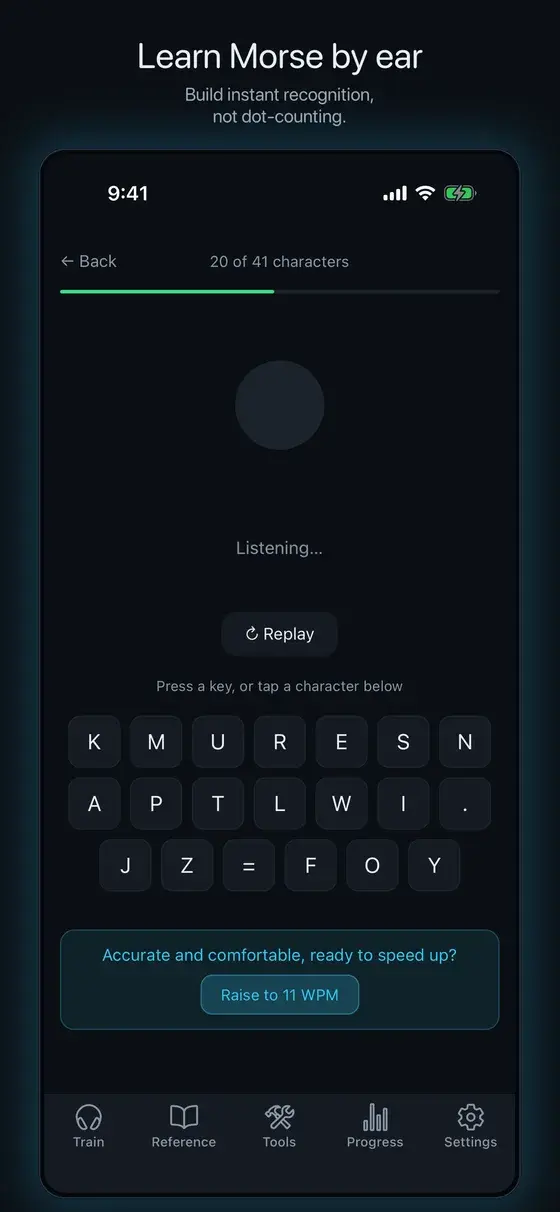
Cadenza, our Morse app for iPhone and Android, has a free Reference screen with the common Q-codes and abbreviations. Its QSO simulator plays a short exchange with a callsign, RST, name, QTH and rig and asks you to copy each field; a callsign trainer and a pile-up drill go with it. The simulator and the trainers are part of Cadenza Pro.
 Cadenza for iPhone and Android
Stop reading Morse. Start hearing it.
Cadenza teaches Morse code by ear with the Koch method: two letters at full speed, then one more each time you get them right. It notices which letters you mix up and drills exactly those.
- All 41 characters, then words, callsigns and QSO practice
- Two-way translator, microphone decoder and Morse postcards
- Sound, light and vibration. Works offline
Sources
- Recommendation ITU-R M.1172. The official Q-code meanings, plus CQ, DE, K, R, BK, AR, AS, CL, PSE and WX
- Recommendation ITU-R M.1677-1. International Morse code, the characters the player sends
- ARRL: Q-Signals. The Q-signals hams use most, in their amateur wording
- ARRL Lab Handbook, Unit 5. Common CW abbreviations, procedure signals and the RST system
- Ethics and Operating Procedures for the Radio Amateur (ON4UN, ON4WW). How a CW contact runs, closing signals, QRP power and cut numbers
Questions
What are Q-codes in ham radio?
Three-letter groups starting with Q that stand for a whole question or answer, such as QTH for location or QSL for I acknowledge receipt. They come from the ITU list for maritime radio and let operators who share no language exchange the basics quickly. Hams use a few dozen of them, on CW and on voice.
What does 73 mean in ham radio?
Best regards. It closes a contact, on CW and on voice. Send or say it once, as 73: forms like 73s or best 73 are considered wrong. 88 means love and kisses.
What does QSL mean?
QSL means I acknowledge receipt, and QSL? asks whether you received. Hams also call the card or electronic record that confirms a contact a QSL.
What does CQ mean in Morse code?
CQ is a general call to any station. An operator sends CQ a few times followed by their callsign and waits for anyone to answer, as in line 2 of the contact above.
Is 20 watts considered QRP?
No. By the usual amateur convention QRP means at most 5 W on CW and 10 W on SSB, so 20 W is above it.