Learn Morse Code by Ear
Two letters, full speed, no counting. Try the first lesson of the Koch method right here.
Listen to each letter a few times, then press Start. You will hear one letter at a time: tap the one you heard.
The Koch method in short
In the 1930s the German psychologist Ludwig Koch found that people learned Morse faster when they heard every letter at full speed from the first day, instead of starting slow and speeding up later. A slow letter sounds different from a fast one, so slow practice has to be unlearned.
His method starts with two letters at the target speed. Once you copy them with about 90 percent accuracy, a third letter joins, then a fourth, until you know them all. Every session runs at real speed; only the number of letters grows.
Farnsworth spacing
Letters at 20 WPM are quick for a beginner, so the gaps between them are stretched. Each letter keeps its full-speed sound and you still have time to answer. As you improve, the gaps shrink until the overall speed matches the letter speed.
How to practice
- Short and daily beats long and weekly: 10 to 20 minutes a day.
- Keep the chart closed while you learn. Name the letter, not its dits and dahs.
- Stuck on a letter? It is usually being confused with one other letter. Practice that pair.
- Once you know the alphabet, move on to words and callsigns, then to real contacts.
 Cadenza for iPhone and Android
Stop reading Morse. Start hearing it.
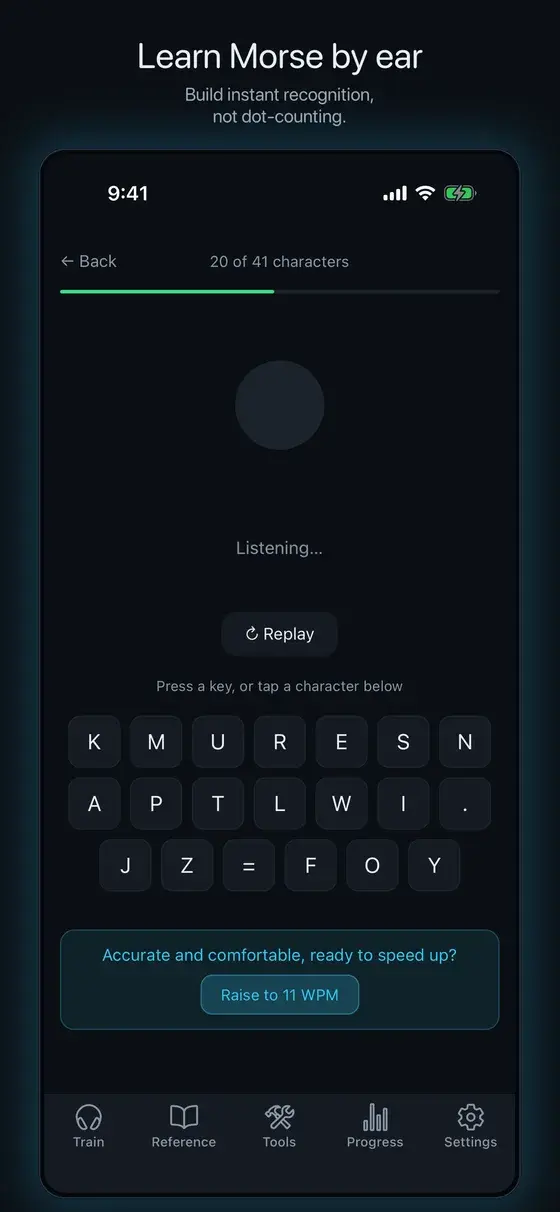
Cadenza teaches Morse code by ear with the Koch method: two letters at full speed, then one more each time you get them right. It notices which letters you mix up and drills exactly those.
- All 41 characters, then words, callsigns and QSO practice
- Two-way translator, microphone decoder and Morse postcards
- Sound, light and vibration. Works offline
Questions
How long does it take to learn Morse code?
It depends on how often you practice more than on talent. With 10 to 20 minutes a day, most people learn the alphabet by ear within weeks, then spend longer building speed.
Do I need a license to learn Morse code?
No. Anyone can learn and use Morse code. A license is only needed to transmit on the amateur radio bands.
Why start at 20 WPM if I am a beginner?
Because the sound of a letter changes with speed. At 20 WPM K is one quick rhythm you recognize; at 5 WPM it is three separate beeps you count. Farnsworth spacing gives you the thinking time instead.